E-bike Brand
Greyp Bikes
my Role
UX/UI Designer
Core Focus
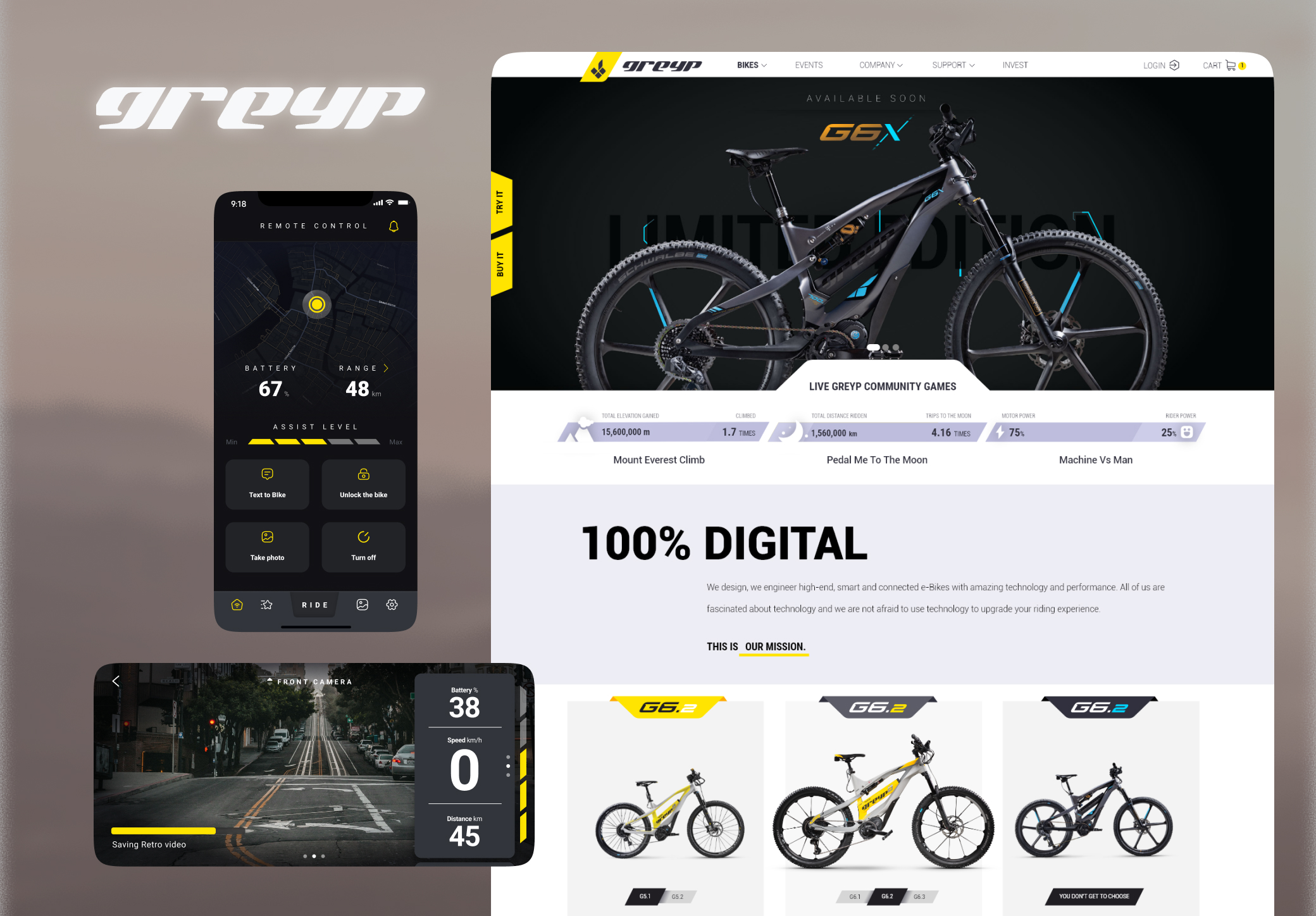
Mobile Companion App, web page
OTHER projects
Diagnostic tool, Digital Enhancements for promotion, Cyklaer ios mobile and Wearable app
Bittersweet Innovation
Joining Greyp was a dream alignment for me. As an avid mountain biker, I saw an incredible opportunity to combine my personal passion with high-impact product design.
The Landscape & Product Bottlenecks
Greyp originated as a creative side project within Rimac Automobili. The vision was ambitious—building connected smart e-bikes long before integrated software was common in the industry. However, rapid innovation brought distinct product design challenges:
Feature-Maturity Gap
Early ideas were wildly innovative, but many lacked user testing and UX maturity, leaving core features misaligned with actual rider needs.
Resource Constraints
Operating in a fast-paced environment with limited dedicated UX resources meant high-potential ideas struggled to mature into polished user experiences as fast as we wanted.
Complex Ecosystem
Building around custom hardware and live cellular/internet connectivity—subject to processing limits, latency, and outdoor display constraints—added technical friction that shaped every UX decision.
Ecosystem overview
integrated bike UI
Mobile companion app
web page
Assembly /diagnostic tool
trade show digital activation
Mobile app
Mobile Experience
My primary focus for the Greyp app was improving core, ground-level usability while refining the high-tech, signature features that set Greyp apart in the industry. By combining qualitative user interviews, analytics data, iterative user journeys, and rapid prototyping, I worked closely with engineering to deliver feasible, high-impact features.
Revision of Terrain-Based Range
User interviews revealed that range anxiety is a major pain point for e-bike riders. Surprisingly, analytics showed our existing "Terrain-Based Range" feature had a high drop-off rate, even though active turn-by-turn navigation was one of the most-used features while riding.
Problem
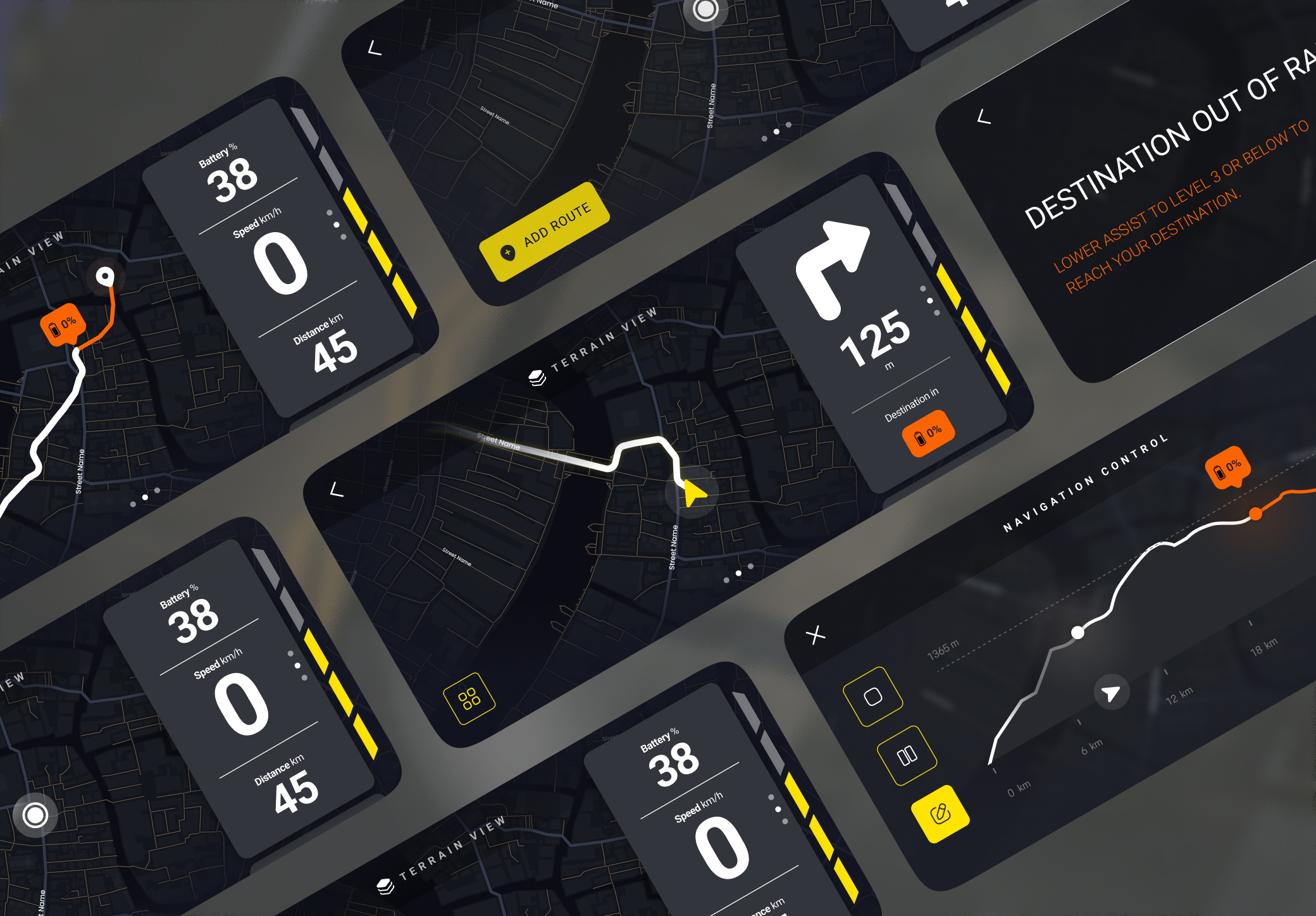
The original feature combined battery charge, average power consumption, position, and elevation maps to draw a radial line of reachable points. However, riders don't travel in a straight line, making the visual data abstract and unhelpful on real trails.
How did we solve the issue
We integrated Terrain-Based Range directly into active Navigation. Instead of showing an abstract radius, the app now dynamically calculates whether a planned route is actually rideable on the current battery charge.
Future Backlog Initiatives
Intelligent Route Planning
Allowing riders to tune planned routes against custom fitness goals and real-time battery thresholds.
Adaptive Auto Assist
Automatically adjusting motor assistance in real time based on terrain and remaining elevation, guaranteeing the rider can reach their destination.
Integrated Telemetry & Camera System
Cameras were the second most-used feature while riding, despite hardware trade-offs like lower resolution and physical vulnerability in off-road crashes. Because the cameras were connected to the bike’s main battery and onboard cellular connection, we turned those constraints into unique UX advantages.
Initial state
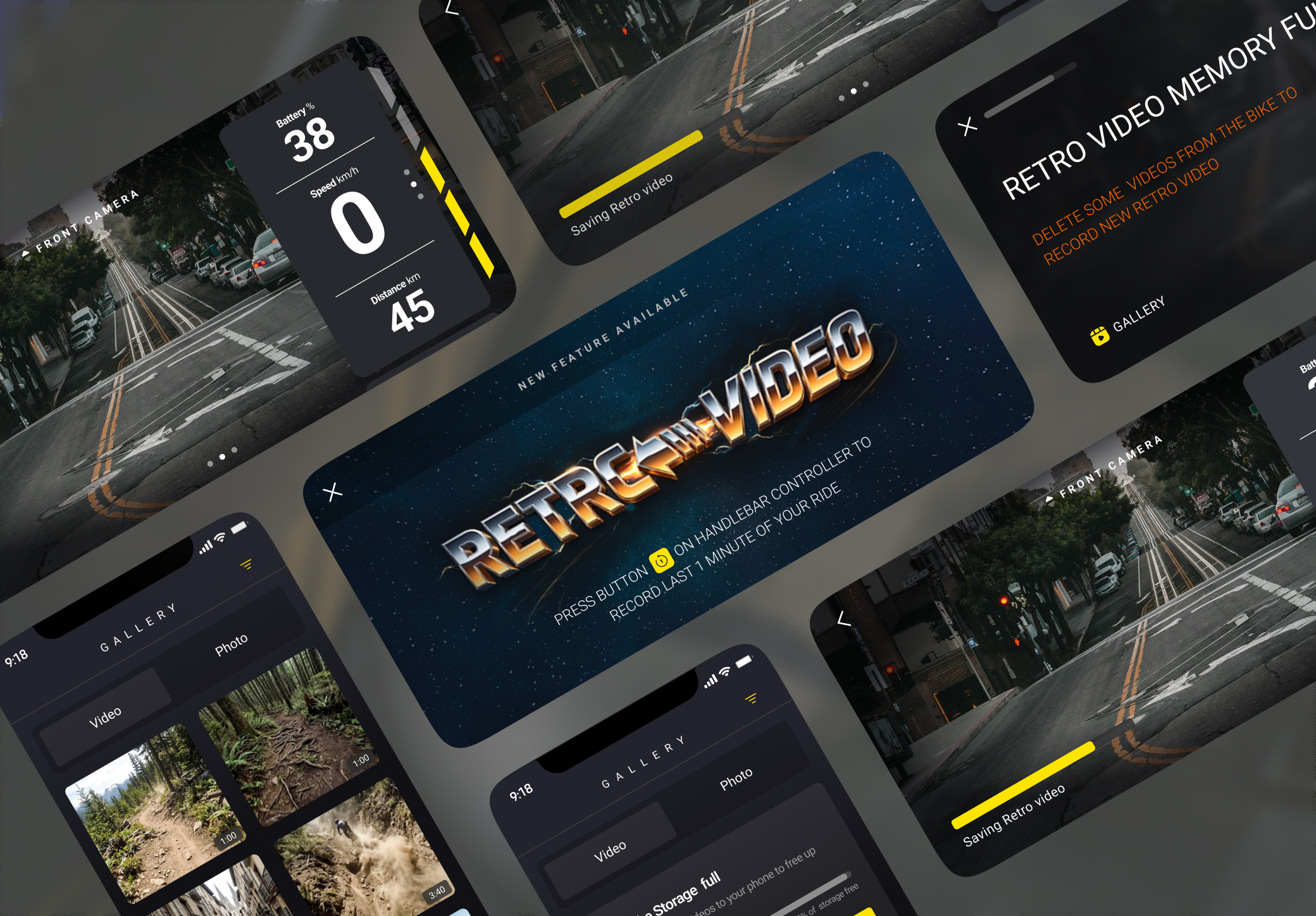
The bike featured front and rear cameras. Riders could view live streams and record clips via the handlebar controller, saving video straight to their phone gallery alongside personal photos.
Improvement
We re-engineered the camera into an automated "black box." The system records continuously in a background loop, enabling riders to retroactively save the last 30 seconds of footage or rely on automatic triggers like crashes, jumps, or extreme G-force events—saved directly into an in-app media gallery.
Future Backlog Initiatives
GoPro Integration
New mounting hardware would have to be engineered, but user would get top video quality from Go Pro, with proven on the ride controls and battery charging from Greyp bikes.
Data-Rich Video Exports
Overlaying rich telemetry data—including rider heart rate, wattage, lean angles, jump metrics, and G-force—directly onto exported video clips for social sharing.
Event-Triggered Recording
Uses telemetry sensors to automatically capture video clips during high-impact moments, removing the need for manual rider input. Automatic recording triggered by high-impact events like crashes, jumps, or extreme G-force.
dIGITAL STAND ENHANCEMENT
Eurobike Trade Show Activation
At Eurobike, the world’s largest bicycle trade show, we introduced our smart e-bike—the Greyp G6. We were eager to showcase our digital capabilities, specifically real-time internet connectivity, integrated cameras, and live telemetry data.
However, we faced a cultural hurdle: the traditional mountain biking community is often skeptical of digital integration, viewing bicycles as simple, purely mechanical machines where software adds unnecessary complexity.
We needed to prove that smart connectivity actually enhances the riding experience.
Problem
As an emerging brand competing against industry giants, our booth location and size were functional, but lacked the high-impact visual presence needed to command attention on a massive show floor.
The Solution:Live Interactive Activation
Geofenced App Gamification
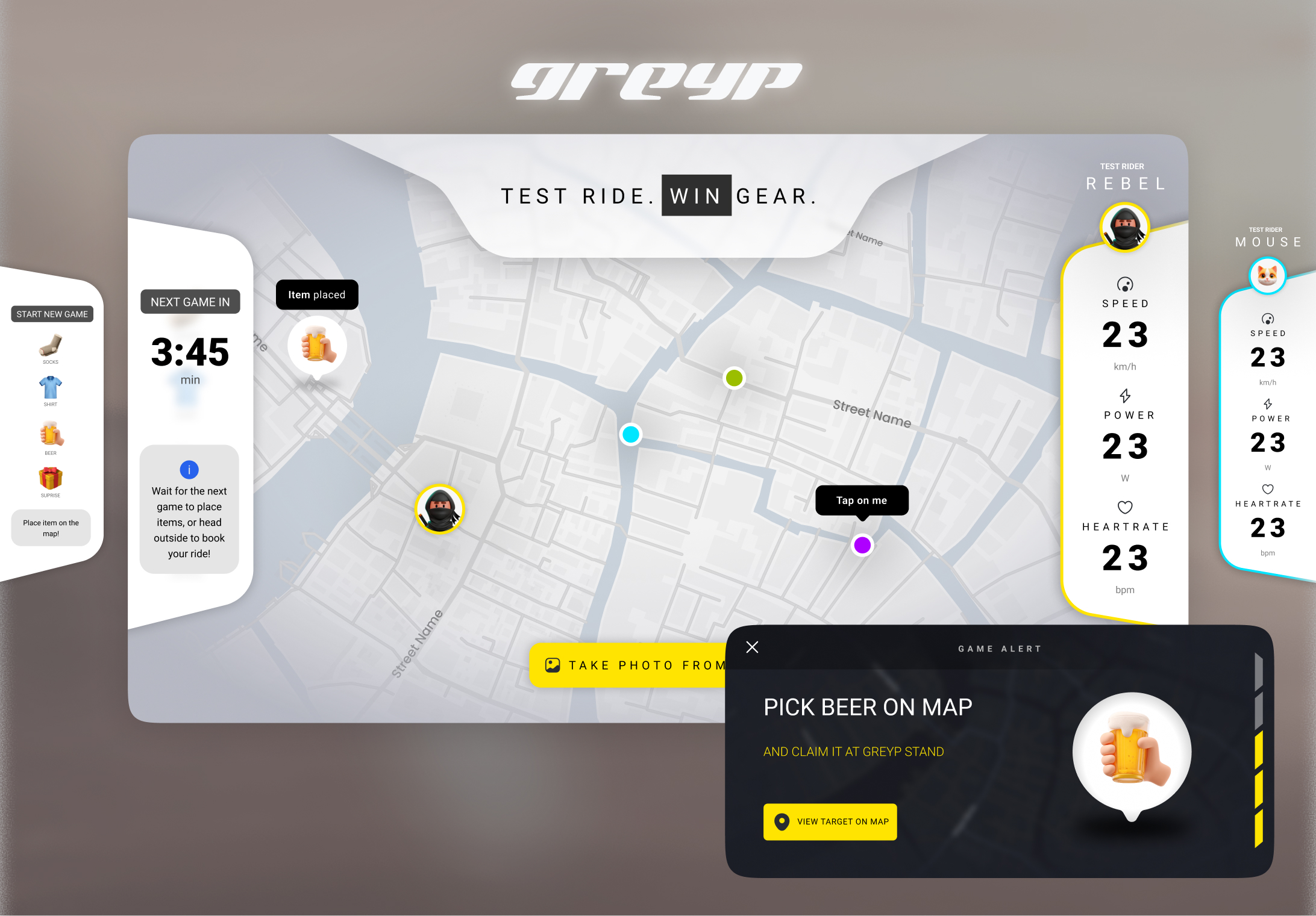
Outdoor test riders played a real-time "treasure hunt" built directly into the mobile app’s active navigation, collecting digital checkpoints around the Eurobike grounds.
Live Telemetry & Video Broadcasting
We installed a massive interactive display at the Greyp indoor booth, live-streaming the riders’ onboard camera footage, telemetry data, and game progress in real time.
Outcomes & Business Impact
Despite operating with limited data and tight hardware constraints, our UX and product design initiatives directly drove commercial interest and critical acclaim for the Greyp brand.
Eurobike Award 2019
The Greyp G6 was honored with the Eurobike Award for the world’s most innovative e-mountain bike, validating our forward-thinking integration of live telemetry, connected software, and rider-focused UX.
U.S. Market Entry
Demonstrating a mature, connected ecosystem helped Greyp secure key dealership partnerships in the North American market, successfully expanding our distribution footprint outside of Europe.
Porsche Acquisition
Our pioneering work in hardware-software integration and connected mobility ultimately led to an acquisition by Porsche eBike Performance, establishing a strong digital foundation that informs next-generation e-mobility products on a global scale.
E-bike Brand
Greyp Bikes
my Role
UX/UI Designer
Core Focus
Mobile Companion App, web page
OTHER projects
Diagnostic tool, Digital Enhancements for promotion, Cyklaer ios mobile and Wearable app
Bittersweet Innovation
Joining Greyp was a dream alignment for me. As an avid mountain biker, I saw an incredible opportunity to combine my personal passion with high-impact product design.
The Landscape & Product Bottlenecks
Greyp originated as a creative side project within Rimac Automobili. The vision was ambitious—building connected smart e-bikes long before integrated software was common in the industry. However, rapid innovation brought distinct product design challenges:
Feature-Maturity Gap
Early ideas were wildly innovative, but many lacked user testing and UX maturity, leaving core features misaligned with actual rider needs.
Resource Constraints
Operating in a fast-paced environment with limited dedicated UX resources meant high-potential ideas struggled to mature into polished user experiences as fast as we wanted.
Complex Ecosystem
Building around custom hardware and live cellular/internet connectivity—subject to processing limits, latency, and outdoor display constraints—added technical friction that shaped every UX decision.
Ecosystem overview
integrated bike UI
Mobile companion app
web page
Assembly /diagnostic tool
trade show digital activation
Mobile app
Mobile Experience
My primary focus for the Greyp app was improving core, ground-level usability while refining the high-tech, signature features that set Greyp apart in the industry. By combining qualitative user interviews, analytics data, iterative user journeys, and rapid prototyping, I worked closely with engineering to deliver feasible, high-impact features.
Revision of Terrain-Based Range
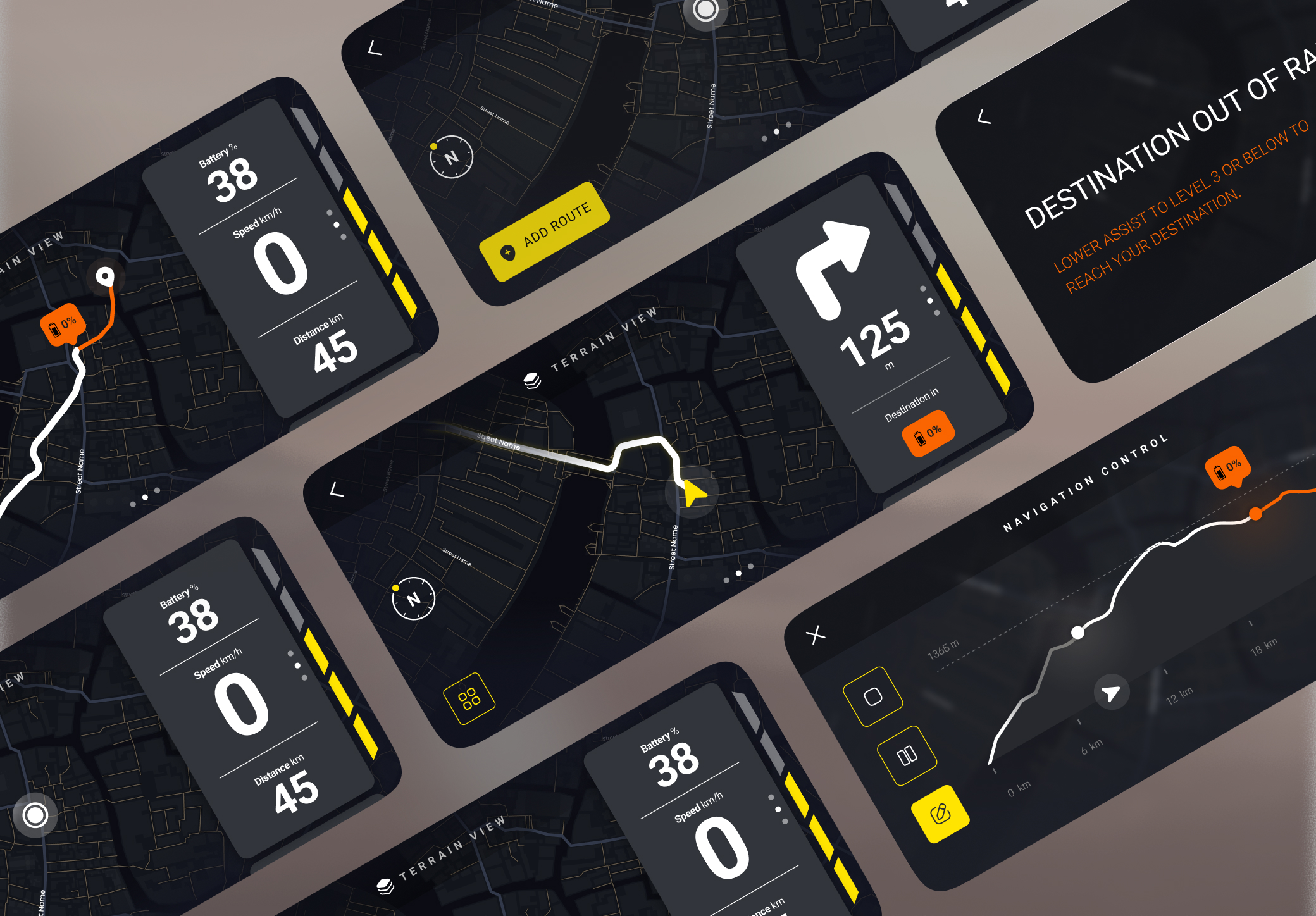
User interviews revealed that range anxiety is a major pain point for e-bike riders. Surprisingly, analytics showed our existing "Terrain-Based Range" feature had a high drop-off rate, even though active turn-by-turn navigation was one of the most-used features while riding.
Problem
The original feature combined battery charge, average power consumption, position, and elevation maps to draw a radial line of reachable points. However, riders don't travel in a straight line, making the visual data abstract and unhelpful on real trails.
How did we solve the issue
We integrated Terrain-Based Range directly into active Navigation. Instead of showing an abstract radius, the app now dynamically calculates whether a planned route is actually rideable on the current battery charge.
Future Backlog Initiatives
Intelligent Route Planning
Allowing riders to tune planned routes against custom fitness goals and real-time battery thresholds.
Adaptive Auto Assist
Automatically adjusting motor assistance in real time based on terrain and remaining elevation, guaranteeing the rider can reach their destination.
Integrated Telemetry & Camera System
Cameras were the second most-used feature while riding, despite hardware trade-offs like lower resolution and physical vulnerability in off-road crashes. Because the cameras were connected to the bike’s main battery and onboard cellular connection, we turned those constraints into unique UX advantages.
Initial state
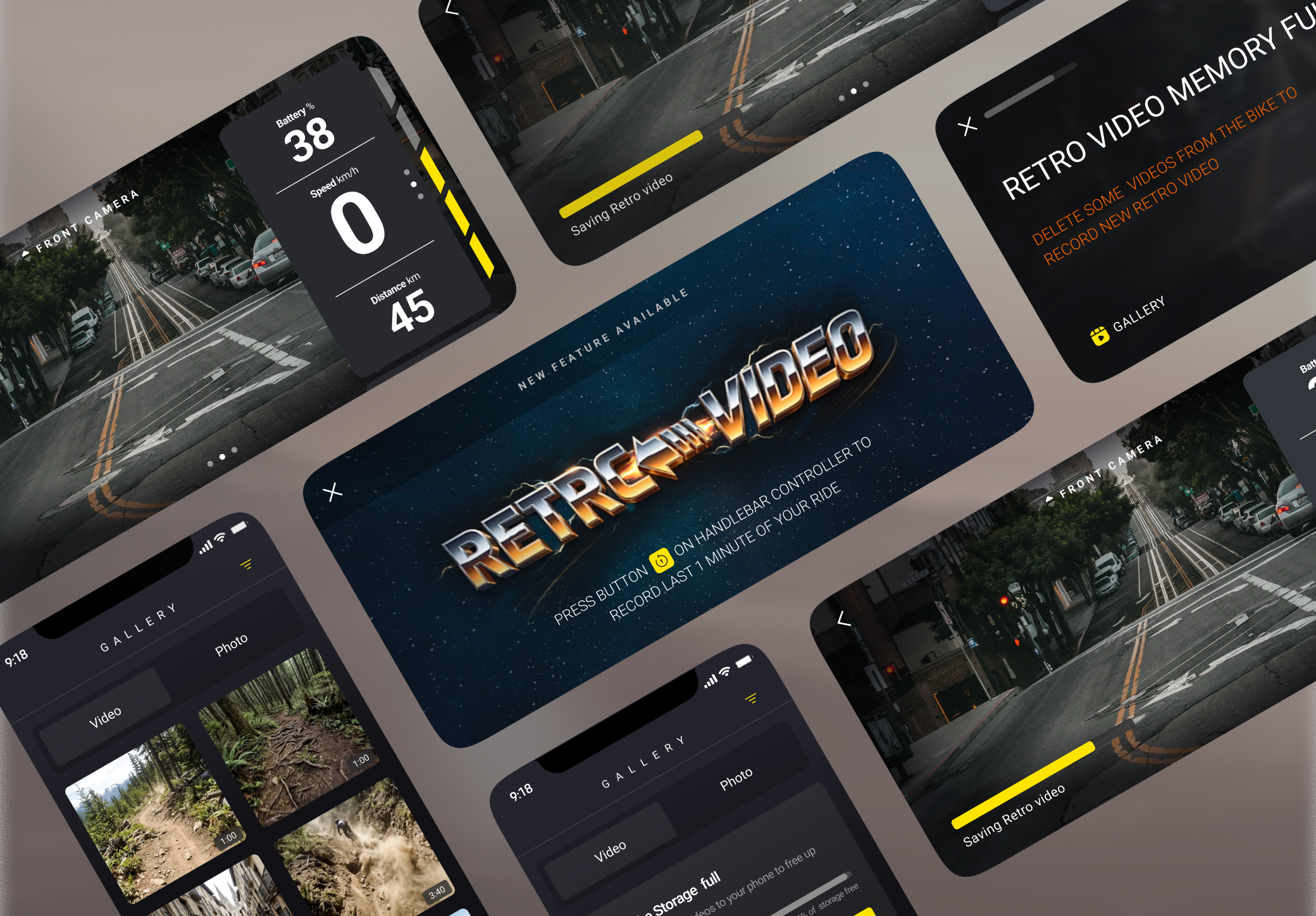
The bike featured front and rear cameras. Riders could view live streams and record clips via the handlebar controller, saving video straight to their phone gallery alongside personal photos.
Improvement
We re-engineered the camera into an automated "black box." The system records continuously in a background loop, enabling riders to retroactively save the last 30 seconds of footage or rely on automatic triggers like crashes, jumps, or extreme G-force events—saved directly into an in-app media gallery.
Future Backlog Initiatives
GoPro Integration
New mounting hardware would have to be engineered, but user would get top video quality from Go Pro, with proven on the ride controls and battery charging from Greyp bikes.
Data-Rich Video Exports
Overlaying rich telemetry data—including rider heart rate, wattage, lean angles, jump metrics, and G-force—directly onto exported video clips for social sharing.
Event-Triggered Recording
Uses telemetry sensors to automatically capture video clips during high-impact moments, removing the need for manual rider input. Automatic recording triggered by high-impact events like crashes, jumps, or extreme G-force.
dIGITAL STAND ENHANCEMENT
Eurobike Trade Show Activation
At Eurobike, the world’s largest bicycle trade show, we introduced our smart e-bike—the Greyp G6. We were eager to showcase our digital capabilities, specifically real-time internet connectivity, integrated cameras, and live telemetry data.
However, we faced a cultural hurdle: the traditional mountain biking community is often skeptical of digital integration, viewing bicycles as simple, purely mechanical machines where software adds unnecessary complexity.
We needed to prove that smart connectivity actually enhances the riding experience.
Problem
As an emerging brand competing against industry giants, our booth location and size were functional, but lacked the high-impact visual presence needed to command attention on a massive show floor.
The Solution: Live Interactive Activation
Geofenced App Gamification
Outdoor test riders played a real-time "treasure hunt" built directly into the mobile app’s active navigation, collecting digital checkpoints around the Eurobike grounds.
Live Telemetry & Video Broadcasting
We installed a massive interactive display at the Greyp indoor booth, live-streaming the riders’ onboard camera footage, telemetry data, and game progress in real time.
Outcomes & Business Impact
Despite operating with limited data and tight hardware constraints, our UX and product design initiatives directly drove commercial interest and critical acclaim for the Greyp brand.
Eurobike Award 2019
The Greyp G6 was honored with the Eurobike Award for the world’s most innovative e-mountain bike, validating our forward-thinking integration of live telemetry, connected software, and rider-focused UX.
U.S. Market Entry
Demonstrating a mature, connected ecosystem helped Greyp secure key dealership partnerships in the North American market, successfully expanding our distribution footprint outside of Europe.
Porsche Acquisition
Our pioneering work in hardware-software integration and connected mobility ultimately led to an acquisition by Porsche eBike Performance, establishing a strong digital foundation that informs next-generation e-mobility products on a global scale.
E-bike Brand
Greyp Bikes
my Role
UX/UI Designer
Core Focus
Mobile Companion App, web page
OTHER projects
Diagnostic tool, Digital Enhancements for promotion, Cyklaer ios mobile and Wearable app
Bittersweet Innovation
Joining Greyp was a dream alignment for me. As an avid mountain biker, I saw an incredible opportunity to combine my personal passion with high-impact product design.
The Landscape & Product Bottlenecks
Greyp originated as a creative side project within Rimac Automobili. The vision was ambitious—building connected smart e-bikes long before integrated software was common in the industry. However, rapid innovation brought distinct product design challenges:
Feature-Maturity Gap
Early ideas were wildly innovative, but many lacked user testing and UX maturity, leaving core features misaligned with actual rider needs.
Resource Constraints
Operating in a fast-paced environment with limited dedicated UX resources meant high-potential ideas struggled to mature into polished user experiences as fast as we wanted.
Complex Ecosystem
Building around custom hardware and live cellular/internet connectivity—subject to processing limits, latency, and outdoor display constraints—added technical friction that shaped every UX decision.
Ecosystem overview
integrated bike UI
Mobile companion app
web page
Assembly /diagnostic tool
trade show digital activation
Mobile app
Mobile Experience
My primary focus for the Greyp app was improving core, ground-level usability while refining the high-tech, signature features that set Greyp apart in the industry. By combining qualitative user interviews, analytics data, iterative user journeys, and rapid prototyping, I worked closely with engineering to deliver feasible, high-impact features.
Revision of Terrain-Based Range
User interviews revealed that range anxiety is a major pain point for e-bike riders. Surprisingly, analytics showed our existing "Terrain-Based Range" feature had a high drop-off rate, even though active turn-by-turn navigation was one of the most-used features while riding.
Problem
The original feature combined battery charge, average power consumption, position, and elevation maps to draw a radial line of reachable points. However, riders don't travel in a straight line, making the visual data abstract and unhelpful on real trails.
How did we solve the issue
We integrated Terrain-Based Range directly into active Navigation. Instead of showing an abstract radius, the app now dynamically calculates whether a planned route is actually rideable on the current battery charge.
Future Backlog Initiatives
Intelligent Route Planning
Allowing riders to tune planned routes against custom fitness goals and real-time battery thresholds.
Adaptive Auto Assist
Automatically adjusting motor assistance in real time based on terrain and remaining elevation, guaranteeing the rider can reach their destination.
Integrated Telemetry & Camera System
Cameras were the second most-used feature while riding, despite hardware trade-offs like lower resolution and physical vulnerability in off-road crashes. Because the cameras were connected to the bike’s main battery and onboard cellular connection, we turned those constraints into unique UX advantages.
Initial state
The bike featured front and rear cameras. Riders could view live streams and record clips via the handlebar controller, saving video straight to their phone gallery alongside personal photos.
Improvement
We re-engineered the camera into an automated "black box." The system records continuously in a background loop, enabling riders to retroactively save the last 30 seconds of footage - saved directly into an in-app media gallery.
Future Backlog Initiatives
GoPro Integration
New mounting hardware would have to be engineered, but user would get top video quality from Go Pro, with proven on the ride controls and battery charging from Greyp bikes.
Data-Rich Video Exports
Overlaying rich telemetry data—including rider heart rate, wattage, lean angles, jump metrics, and G-force—directly onto exported video clips for social sharing.
Event-Triggered Recording
Uses telemetry sensors to automatically capture video clips during high-impact moments like crashes, jumps, or extreme G-force, removing the need for manual rider input.
dIGITAL STAND ENHANCEMENT
Eurobike Trade Show Activation
At Eurobike, the world’s largest bicycle trade show, we introduced our smart e-bike—the Greyp G6. We were eager to showcase our digital capabilities, specifically real-time internet connectivity, integrated cameras, and live telemetry data.
However, we faced a cultural hurdle: the traditional mountain biking community is often skeptical of digital integration, viewing bicycles as simple, purely mechanical machines where software adds unnecessary complexity.
We needed to prove that smart connectivity actually enhances the riding experience.
Problem
As an emerging brand competing against industry giants, our booth location and size were functional, but lacked the high-impact visual presence needed to command attention on a massive show floor.
The Solution: Live Interactive Activation
Geofenced App Gamification
Outdoor test riders played a real-time "treasure hunt" built directly into the mobile app’s active navigation, collecting digital checkpoints around the Eurobike grounds.
Live Telemetry & Video Broadcasting
We installed a massive interactive display at the Greyp indoor booth, live-streaming the riders’ onboard camera footage, telemetry data, and game progress in real time.
Outcomes & Business Impact
Despite operating with limited data and tight hardware constraints, our UX and product design initiatives directly drove commercial interest and critical acclaim for the Greyp brand.
Eurobike Award 2019
The Greyp G6 was honored with the Eurobike Award for the world’s most innovative e-mountain bike, validating our forward-thinking integration of live telemetry, connected software, and rider-focused UX.
U.S. Market Entry
Demonstrating a mature, connected ecosystem helped Greyp secure key dealership partnerships in the North American market, successfully expanding our distribution footprint outside of Europe.
Porsche Acquisition
Our pioneering work in hardware-software integration and connected mobility ultimately led to an acquisition by Porsche eBike Performance, establishing a strong digital foundation that informs next-generation e-mobility products on a global scale.